


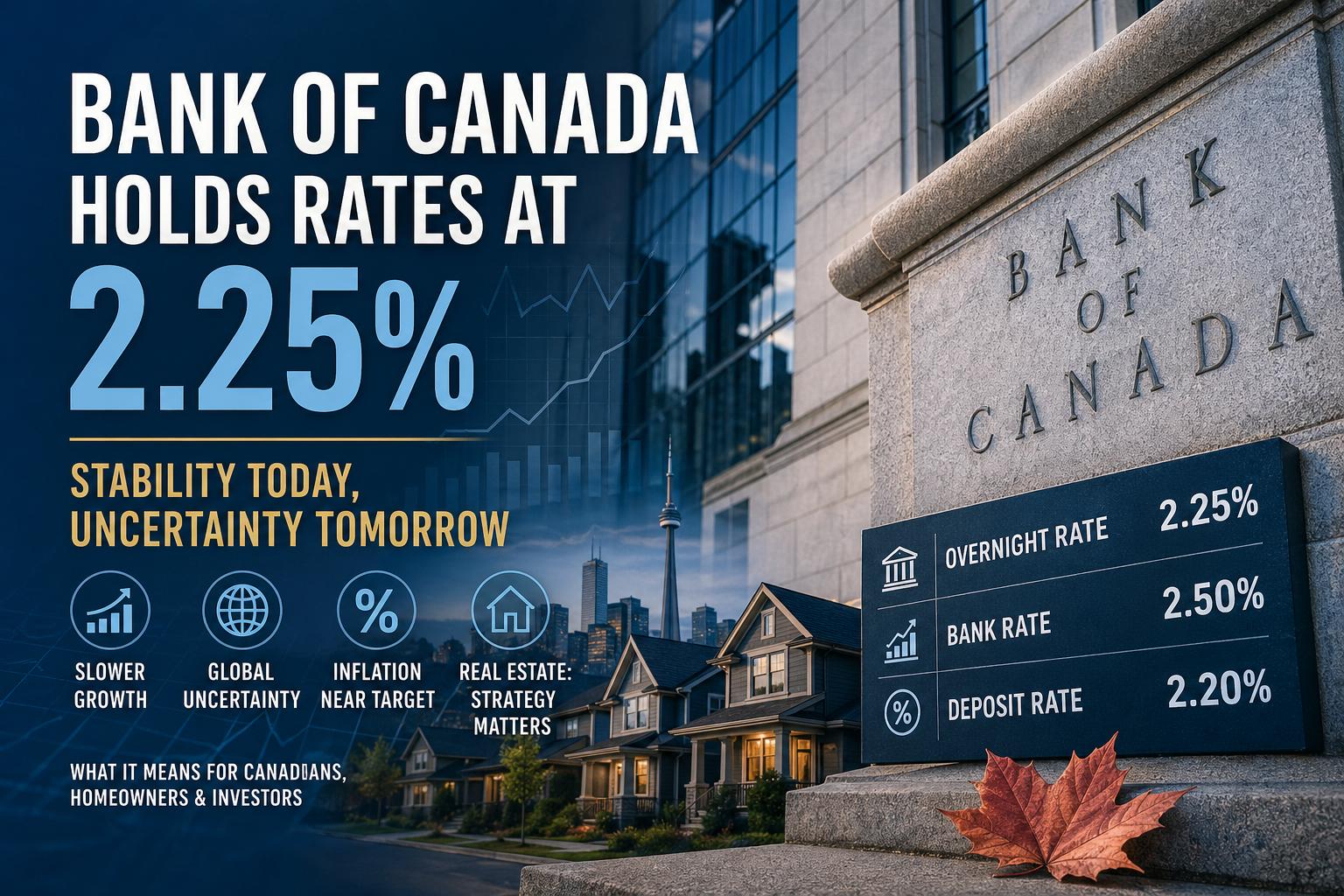
Today, Wednesday, April 29, 2026, the Bank of Canada (BoC) announced its latest interest rate decision, a moment that homeowners and prospective buyers across Montreal have been watching with bated breath. In a move that reflects both caution and a complex global economic landscape, the Bank has decided to maintain the overnight rate at 2.25%. The Bank Rate remains at 2.50%, and the deposit rate at 2.20%.
At North East Real Estate & Mortgage Agency, we understand that these announcements can often feel like a whirlwind of numbers and abstract economic terms. However, these decisions have a direct, tangible impact on your monthly mortgage payments and your long-term financial planning. In this article, we will break down the “why” behind today’s decision, examine the global factors at play, from Middle Eastern oil prices to US trade tariffs, and discuss what this means for the Montreal real estate market.
Understanding the “Hold”: Why 2.25% Matters
When the Bank of Canada decides to “hold” the rate, it essentially means they are hitting the pause button. They believe the current interest rate is sufficiently restrictive to keep inflation moving toward its target, but they aren’t yet confident enough in the economic data to begin cutting rates further.
The boc prime rate, which is heavily influenced by this overnight rate, will remain stable for the time being. For many Montrealers, this provides a brief window of predictability. If you have a variable-rate mortgage, your interest rate will likely stay exactly where it is today. If you are looking to renew or purchase, the stability in the overnight rate helps stabilize bond yields, which in turn influences fixed mortgage rates.
The Global Wildcards: Oil and Geopolitics
One of the most significant takeaways from the Bank’s April 29 press release was the emphasis on international volatility. We are currently navigating a period of intense geopolitical stress, particularly the ongoing conflict in the Middle East.
The Energy Equation
The Middle East war has caused significant fluctuations in global oil prices. For Canada, a major energy exporter, this is a double-edged sword. While higher oil prices can boost the economy in provinces like Alberta, they also act as a “tax” on consumers at the pump and through increased transportation costs for goods. This inflationary pressure makes it difficult for the Bank of Canada to lower interest rates, as doing so might over-stimulate an economy already dealing with rising energy costs.
Trade Uncertainty and US Tariffs
Adding to the complexity is our relationship with our largest trading partner. The Bank specifically noted that US trade tariffs are causing a cloud of uncertainty. Tariffs increase the cost of imported goods, which contributes to domestic inflation. Furthermore, they can lead to reduced business investment as companies wait to see how trade policies evolve.
For a homeowner in Montreal, this might seem distant, but it isn’t. If the Canadian economy slows down due to trade friction, the Bank of Canada must balance the need to fight inflation (by keeping rates high) with the need to support a weakening economy (by potentially lowering rates). Today’s hold at 2.25% is the Bank’s way of saying they are monitoring these “external shocks” before making their next move.

The Economic Forecast: GDP and the Path to 2% Inflation
The Bank of Canada’s outlook for 2026 is one of “modest growth.” They are projecting GDP growth to be approximately 1.2% for 2026. This is a relatively slow pace, suggesting that the “higher for longer” interest rate environment is doing its job of cooling the economy.
The Inflation Timeline
The ultimate goal of the Bank is to bring inflation back to its 2% target. According to today’s announcement, the Bank expects to hit that target in 2027. This is a crucial piece of information for any canada mortgage rates forecast. It suggests that while we may see some rate relief in late 2026 or 2027, the era of “ultra-low” rates (the 1% levels we saw years ago) is likely not returning anytime soon.
When looking at a mortgage rate canada prediction, most economists agree that stability is the theme for the next few quarters. The Bank is waiting for clear evidence that inflation is not just falling, but staying down, despite the pressures from oil and tariffs.
What This Means for Montreal Homeowners
Montreal remains one of Canada’s most vibrant but complex real estate markets. Whether you are in the West Island, Plateau, or Laval, today’s rate hold affects you differently depending on your situation.
1. For Current Variable-Rate Holders
If you are currently in a variable-rate mortgage, today’s news is a bit of a relief, your payments aren’t going up. However, the anticipated “rapid descent” of rates that some were hoping for hasn’t materialized. It is essential to review your budget and ensure you can manage your current payments through the end of the year.
2. For Those Renewing in 2026
If your mortgage is up for renewal this year, you are likely coming off a much lower rate from five years ago. A canada mortgage rates forecast suggests that while rates have peaked, they are settling at a “new normal.” Working with experienced real estate brokers in montreal and mortgage specialists can help you navigate whether to choose a shorter-term fixed rate or stay variable in hopes of a 2027 drop.
3. For First-Time Buyers
The Montreal market has seen a slight cooling in demand, which can be an advantage for buyers. With the BoC holding rates, you have a more stable environment to get pre-approved. Knowing that the boc prime rate isn’t jumping tomorrow gives you more confidence in your purchasing power. We encourage you to explore our properties for sale to see what fits your new budget.
Strategic Advice: Navigating the Uncertainty
At North East Real Estate & Mortgage Agency, we believe in proactive financial management. Here are several steps we recommend considering following today’s announcement:
- Get a Professional Review: Don’t wait until your renewal date to look at your options. Contact our mortgage team for a comprehensive review of your current strategy.
- Stress-Test Your Budget: With inflation projected to take until 2027 to stabilize, ensure your household budget can withstand current costs for the next 18–24 months.
- Monitor Energy Trends: Since oil prices are a major factor for the BoC, keeping an eye on global energy news can give you a “early warning” of where rates might go next.
- Explore Refinancing: If you have high-interest debt elsewhere, it may still be a good time to look into mortgage services that consolidate that debt into your lower-rate mortgage.

Looking Ahead: The “Wait and See” Summer
Today’s decision by the Bank of Canada highlights a transition period. We are moving away from the era of aggressive rate hikes, but we aren’t quite into the era of significant rate cuts. The Canadian economy is resilient, but the “modest” 1.2% growth forecast means we must be diligent and strategic with our real estate investments.
The interplay between global conflicts, trade tariffs, and domestic inflation creates a narrow path for the Bank of Canada. As your trusted mortgage broker, our job is to help you stay on that path safely.
Summary of Key Points:
- Rate Hold: The overnight rate stays at 2.25%.
- Inflation Target: 2% expected by 2027.
- Growth: Canada’s GDP growth is projected at 1.2% for 2026.
- Risk Factors: Oil prices (Middle East conflict) and US trade tariffs are the primary concerns for the Bank.
- Montreal Impact: Expect a stable but “higher for longer” environment for mortgage rates throughout the summer.
We invite you to stay informed by visiting our blog regularly for updates. If you have questions about how today’s announcement specifically impacts your home value or your mortgage renewal, please contact us. Our team of experts is here to provide the guidance and clarity you need in these changing times.
Whether you are looking to buy, sell, or refinance, remember that information is your strongest asset. Let’s work together to make sure your next move is a smart one.